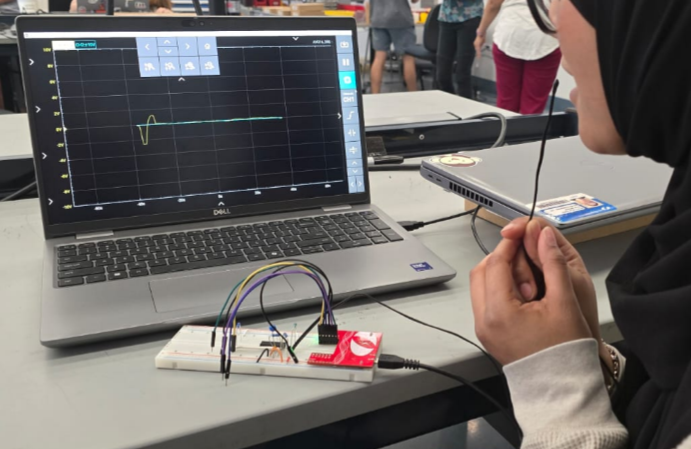
Our goal was to design a system capable of detecting human breaths using a temperature based sensor while minimizing noise, drift, and environmental interference. The circuit needed to reliably convert thermistor resistance changes into a measurable voltage signal that could be amplified, filtered, and analyzed to calculate breaths per minute (BPM).
We used a thermistor to detect the warm air produced by each exhale. As temperature increased, the thermistor’s resistance decreased, creating small voltage changes in the circuit.
The system consisted of:
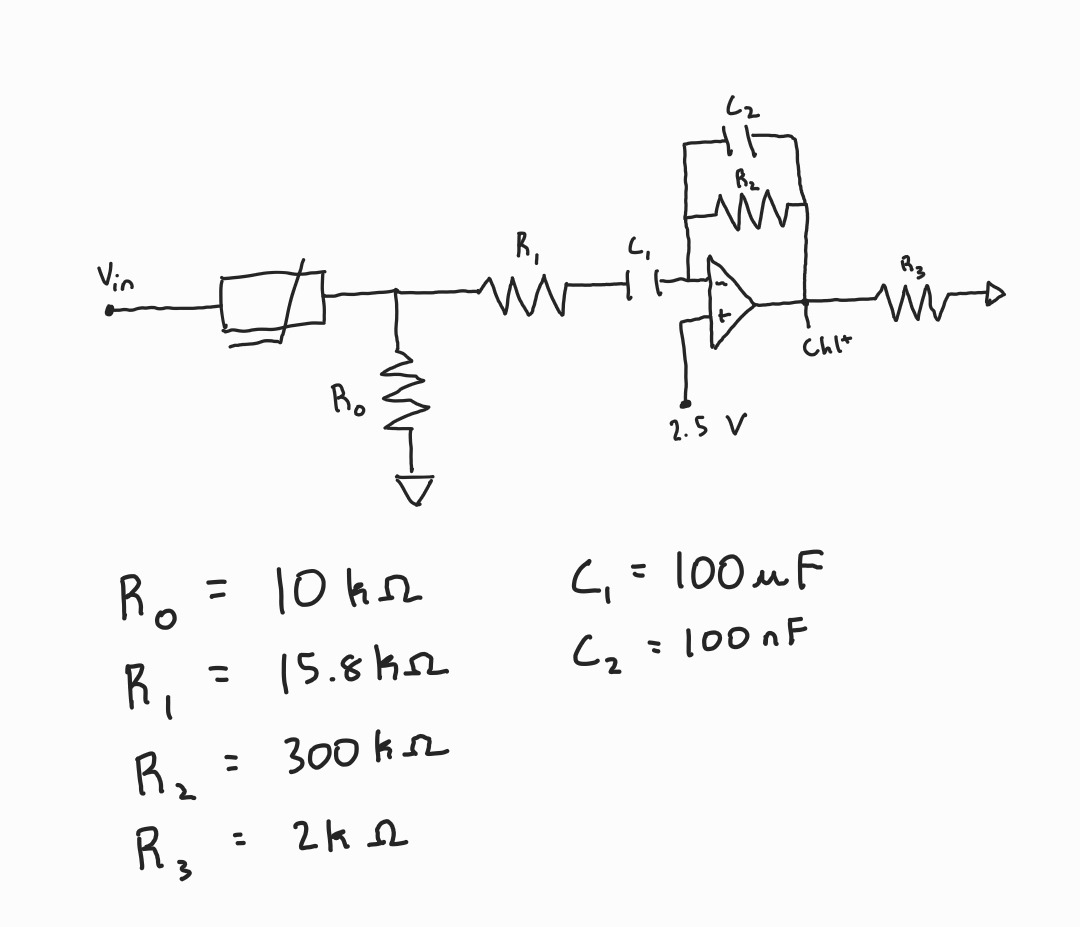
The amplifier boosts the small voltage changes produced by the thermistor.
The gain is set by the resistor ratio:
Gain = 1 + (R2 / R3)
R2 = 300 kΩ
R3 = 2 kΩ
Therefore:
Gain = 1 + (300 kΩ / 2 kΩ) = 151
We designed a 2-stage band-pass filter to isolate the breathing frequency range.
R0 = 10 kΩ
C1 = 100 µF
Cutoff frequency:
fc ≈ 0.16 Hz
This removes very slow drift from temperature changes or ambient heat.
R1 = 15.8 kΩ
C2 = 100 nF
Cutoff frequency:
fc ≈ 100 Hz
This removes high-frequency electrical noise.
Together, these two stages form a band-pass filter that keeps signals in the typical breathing frequency range (about 0.2 to 0.5 Hz) while blocking noise outside that range.
Every exhale produced a temperature spike, reducing the thermistor’s resistance. The voltage divider converted this into a measurable voltage change. The amplifier boosted the signal, and the band-pass filter isolated the breathing pattern. Peaks in the filtered signal corresponded to individual breaths and were counted to compute BPM.
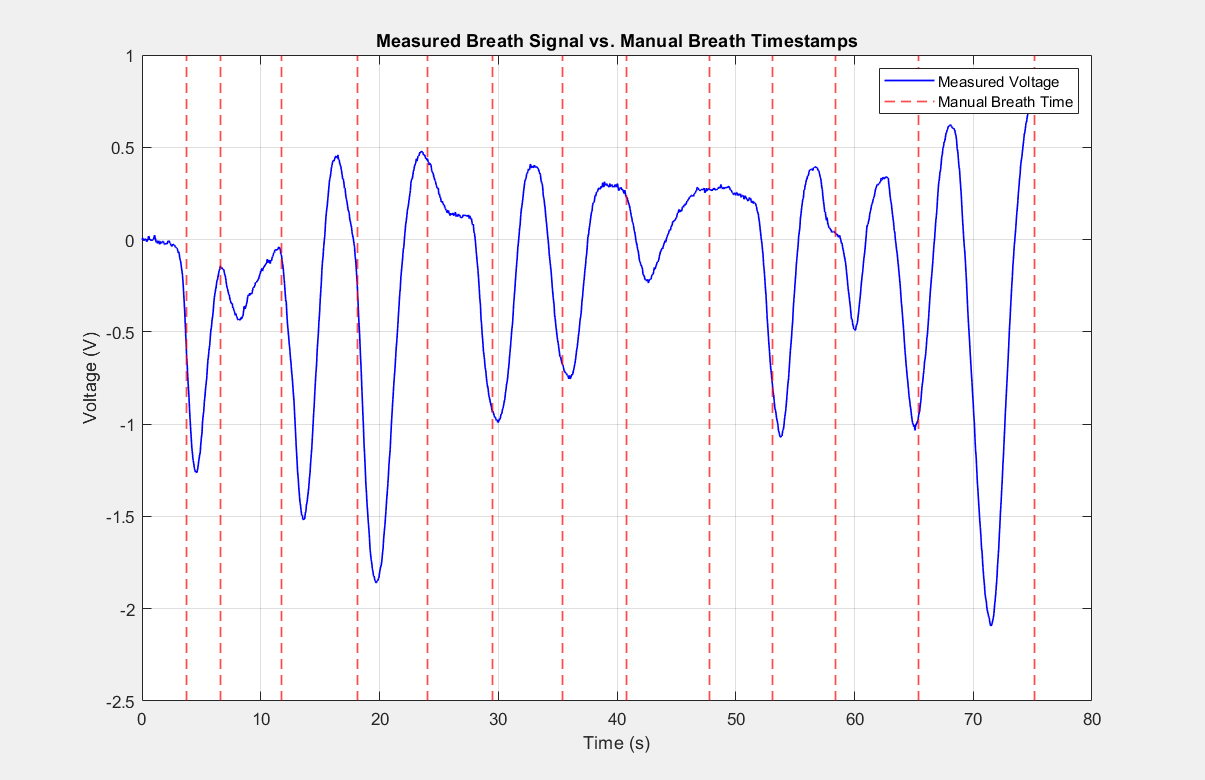
I produced 13 breaths over 75 seconds, giving me a BPM of about 10.4. This is slightly below the normal resting adult range (12–20 BPM), but still reasonable valid, especially if relaxed or holding slow, steady breaths.
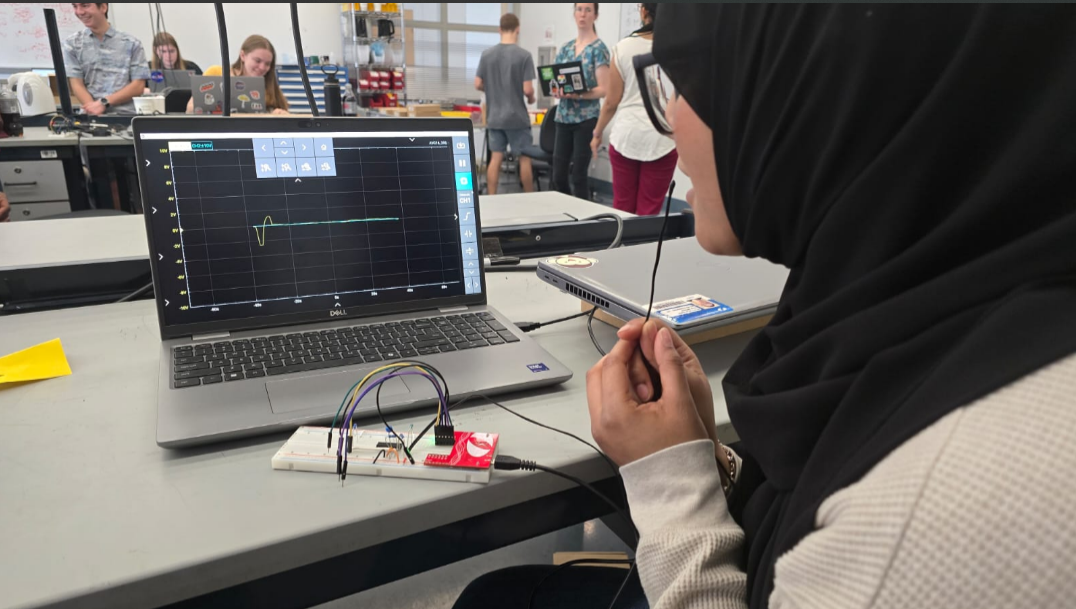
The oscilloscope output showed clean, distinct peaks, confirming that the sensor, amplifier, and filter chain successfully detected each breath.
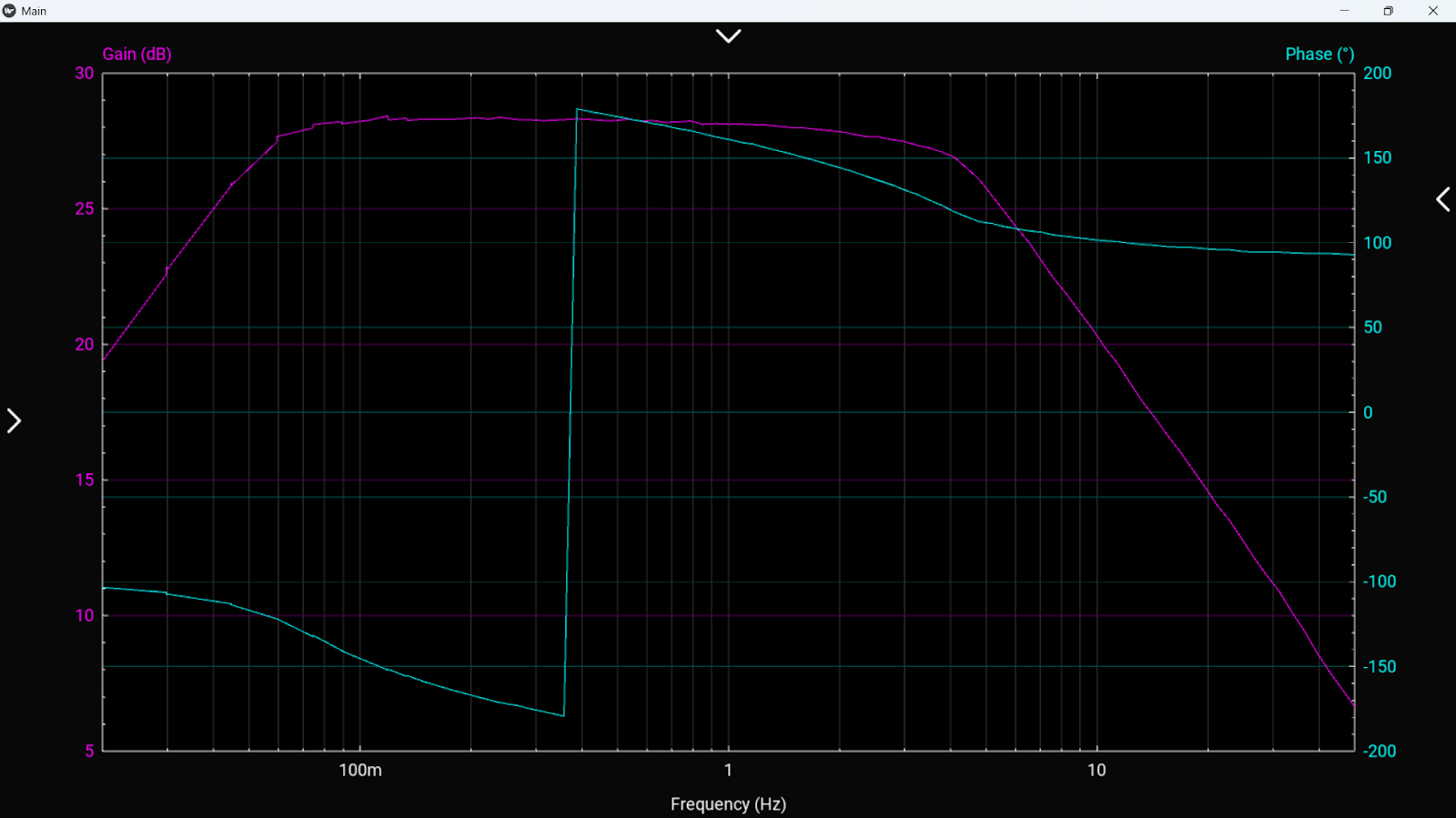
The Bode plot confirmed:
The project successfully demonstrated how a temperature based sensor, combined with analog filtering and amplification, can reliably detect human respiration.
We achieved:
This project strengthened my understanding of analog circuits, instrumentation design, and practical signal conditioning for real world measurement systems.