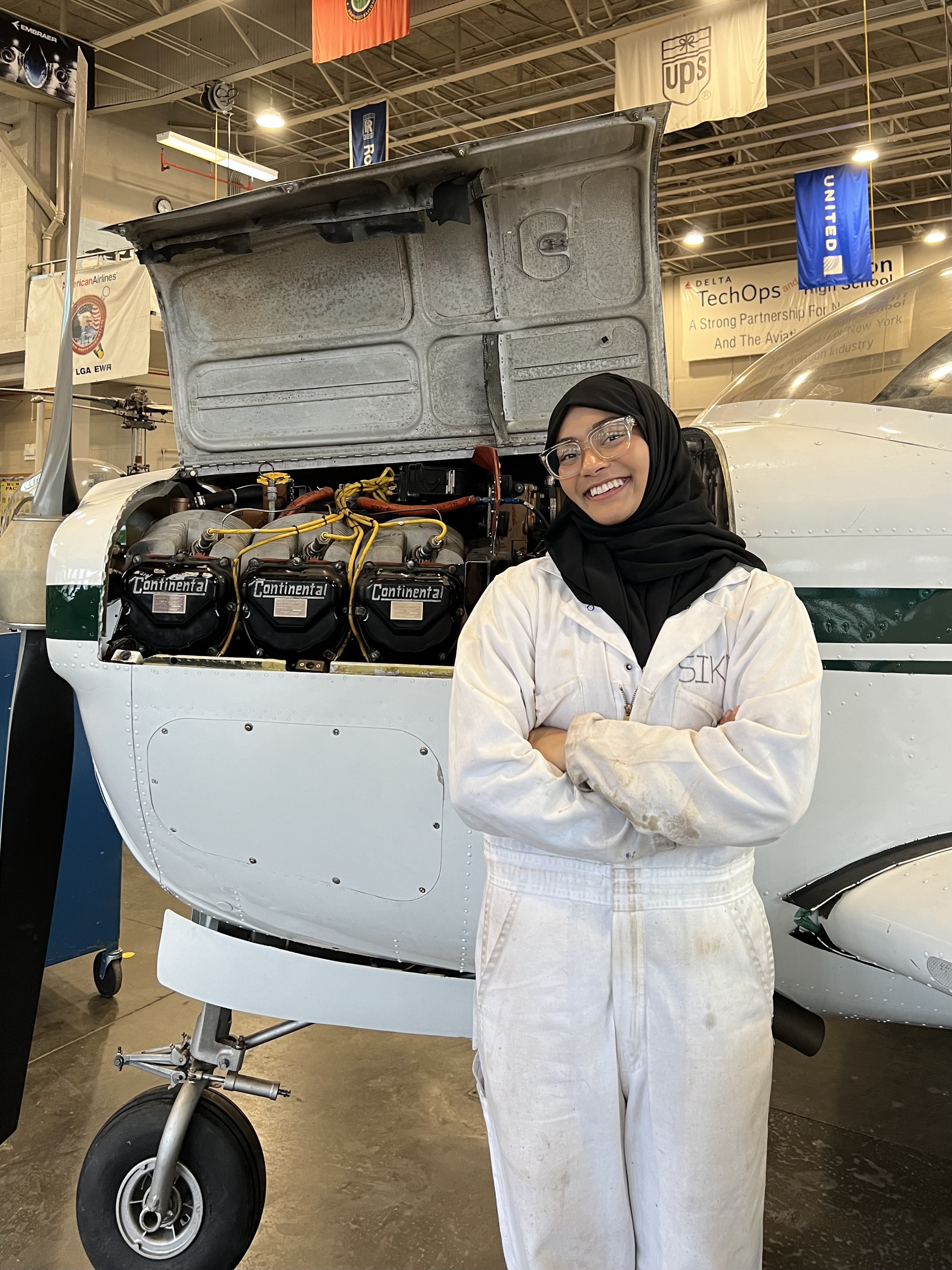
I completed full FAA curricula in General, Airframe, and Powerplant, covering everything from sheet-metal fabrication and composite repair to reciprocating & turbine engine theory, fuel & ignition systems, thermodynamics, lubrication, propellers, and advanced diagnostics.
GENERAL
Chapter: Regulations, Documentation, & Human Factors
Training on FAA rules (Part 43/91), required maintenance documentation, airworthiness standards, and human factors. Builds awareness of regulatory constraints, error chains, and safe operational decision-making.
Chapter: Mathematics & Physics for Aviation
Applied math and physics used for load calculations, pressures, moments, clearances, and performance analysis. Establishes the groundwork for engineering calculations and troubleshooting.
Chapter: Aircraft Drawings & Schematics
Reading engineering drawings, wiring diagrams, exploded views, and symbol conventions. A direct precursor to CAD literacy, tolerance interpretation, and mechanical design communication.
Chapter: Aircraft Materials, Hardware & Processes
Hands-on understanding of aluminum alloys, corrosion types, heat treatment, composite basics, and the mechanical behavior of fasteners and rivets. Enables judgment about material selection and repair methods.
Chapter: Cleaning & Corrosion Control
How corrosion forms, how to prevent it, what treatments to apply, and how to evaluate structural integrity.
Chapter: Fluid Lines & Fittings
Fabrication and inspection of rigid/flexible lines, bending, flaring, AN/MS fitting selection, routing rules, and leak troubleshooting. Builds understanding of hydraulic system design constraints.
Chapter: Weight & Balance
Center of gravity calculations, moment arms, loading envelopes, and performance effects. Teaches systems thinking and safety-critical analysis.
Chapter: Electrical Fundamentals
DC theory, wiring, grounding, circuit protection, connectors, and troubleshooting. Gives insight into system integration, bonding, and failure modes relevant to avionics and mechanical systems.
Chapter: Inspection Fundamentals
How inspections are performed, what kinds of defects matter, and how to determine serviceability of components.
AIRFRAME
Chapter: Aerodynamics & Aircraft Structures
Fundamentals of lift, drag, stability, load paths, and how structural components carry mechanical loads. Helps engineers understand why aircraft are shaped and built the way they are.
Chapter: Sheet-Metal Construction & Repairs
Drilling, riveting, dimpling, forming, patching, structural repair principles, damage evaluation. Teaches manufacturability, tolerance stacking, and structural integrity.
Chapter: Composite Structures
Layups, resins, curing, inspection, delamination detection. Provides background in the behavior of composite materials and failure modes.
Chapter: Welding & Material Joining
Oxyfuel, TIG/MIG basics, joint design, heat-affected zones, weld inspection. Useful for prototyping, fabrication, and structural joining.
Chapter: Control Systems & Rigging
Cables, pulleys, bellcranks, linkages, trim systems. Covers rigging procedures and how control geometry affects aircraft behavior.
Chapter: Hydraulic & Pneumatic Systems
Actuators, reservoirs, accumulators, pressure regulators, brakes, and landing gear systems. Provides real-world understanding of fluid power systems.
Chapter: Landing Gear Systems
Mechanics of retraction, shock absorption, braking, and steering. Shows how mechanical subsystems integrate under load.
Chapter: Environmental & Oxygen Systems
Pressurization, air-conditioning, bleed air, oxygen delivery. Relates to thermal management and human-system interface.
Chapter: Fire Protection, Ice & Rain Control
Detection loops, extinguishing agents, pneumatic anti-ice, electrical de-icing. Relevant to safety-critical system design.
Chapter: NDT (Non-Destructive Testing)
Dye-penetrant, eddy current, ultrasonic inspections. Provides a foundation in detecting subsurface defects and evaluating structural integrity.
POWERPLANT
Chapter 1: Engine Fundamentals & Construction
Covers the design of reciprocating engines (crankcases, pistons, rods, valves) and turbine engines (compressor → combustor → turbine). Teaches cycle analysis, power output, efficiency, and mechanical/thermal behavior of engines.
Chapter 2: Fuel & Fuel Metering Systems
Explains carburetion, fuel injection, mixture control, metering, and FADEC systems. Demonstrates how engines manage air-fuel ratios under varying loads and altitude.
Chapter 3: Induction & Exhaust Systems
Air intake design, filtering, turbocharging & supercharging, and exhaust flow. Helps you understand airflow management, boost control, icing, and thermal performance.
Chapter 4: Ignition & Electrical Systems
Magnetos, spark timing, ignition harnesses, turbine ignition exciters, electrical wiring, bonding, connectors, and troubleshooting. Builds intuition around timing, spark energy, and system reliability.
Chapter 5: Engine Starting Systems
Electric starters, inertia starters, air turbine starters, and large-engine starting sequences. Shows the mechanical and electrical processes required to bring engines online safely.
Chapter 6: Lubrication & Cooling Systems
Dry-sump and wet-sump oil systems, viscosity, pumps, coolers, bypass valves, turbine lubricant flow, and engine cooling strategies. Essential for understanding failure modes and thermal management.
Chapter 7: Propellers & Power Transmission
Fixed-pitch and constant-speed props, governors, feathering systems, and reduction gearing. Connects aerodynamic principles with mechanical actuation and power output.
Chapter 8: Engine Removal & Installation
Rigging controls, aligning mounts, reconnecting systems, inspection steps, test runs, and verification. Emphasizes system integration and maintenance-driven design.
Chapter 9: Fire Protection Systems
Detection loops (thermocouple, optical, pneumatic), extinguishing agents, warning systems, and turbine fire zone design. Useful for understanding safety system architecture.
Chapter 10: Engine Maintenance, Overhaul, & Troubleshooting
Top/major overhaul procedures, teardown inspections, NDT, cylinder compression testing, turbine component inspection, and test cell operation. Builds the skillset for failure analysis and performance verification.
Chapter 11: Light-Sport Engines (Rotax, Jabiru, VW Conversions)
Covers two-stroke and four-stroke light aircraft engines, carb synchronization, gearbox checks, turbo control, and small-engine operational quirks.